
Decoding the FCC’s New 6G Spectrum Allocations: What U.S. Tech Companies Need to Know by Q3 2026
The dawn of 6G is not just a distant technological dream; it’s a rapidly approaching reality that will fundamentally reshape the landscape of wireless communication. For U.S. tech companies, understanding and preparing for the Federal Communications Commission’s (FCC) new 6G spectrum allocations is not merely an option but a critical imperative. With a target horizon of Q3 2026 for significant regulatory clarity and initial deployments, the time to strategize, innovate, and adapt is now. This comprehensive guide will delve into the intricacies of the upcoming FCC 6G spectrum decisions, their implications, and the proactive steps U.S. tech companies must take to remain competitive and compliant.
The 6G Imperative: Beyond Speed
While 5G has brought unprecedented speeds and low latency, 6G promises to transcend these capabilities, ushering in an era of truly ubiquitous connectivity, intelligent environments, and hyper-personalized services. Imagine holographic communication, real-time AI-powered decision-making at the edge, fully autonomous systems, and seamless integration of the physical and digital worlds through advanced sensing and haptic feedback. These advancements, however, are entirely dependent on the availability and efficient utilization of massive amounts of new spectrum. The FCC 6G spectrum allocation will be the bedrock upon which these transformative technologies are built.
Why Q3 2026 is a Critical Benchmark
- Regulatory Certainty: By this point, the FCC is expected to have made substantial progress in identifying and allocating specific frequency bands for 6G research, development, and initial commercialization. This clarity is vital for investment and strategic planning.
- Technology Maturation: While 6G standards are still evolving, key technological enablers will be nearing maturity, allowing companies to begin prototyping and testing solutions within defined spectrum parameters.
- Global Alignment: International bodies, such as the International Telecommunication Union (ITU), will also be advancing their discussions on 6G, and the FCC’s decisions will influence and be influenced by global harmonization efforts. U.S. tech companies need to be prepared for both domestic and international market dynamics.
- Market Readiness: Early movers in 6G will gain a significant competitive advantage, shaping the ecosystem and capturing market share. Waiting until after 2026 could mean falling behind.
The Q3 2026 timeline isn’t arbitrary. It represents a crucial window for several reasons:
Advertisements
Understanding the Potential 6G Spectrum Bands
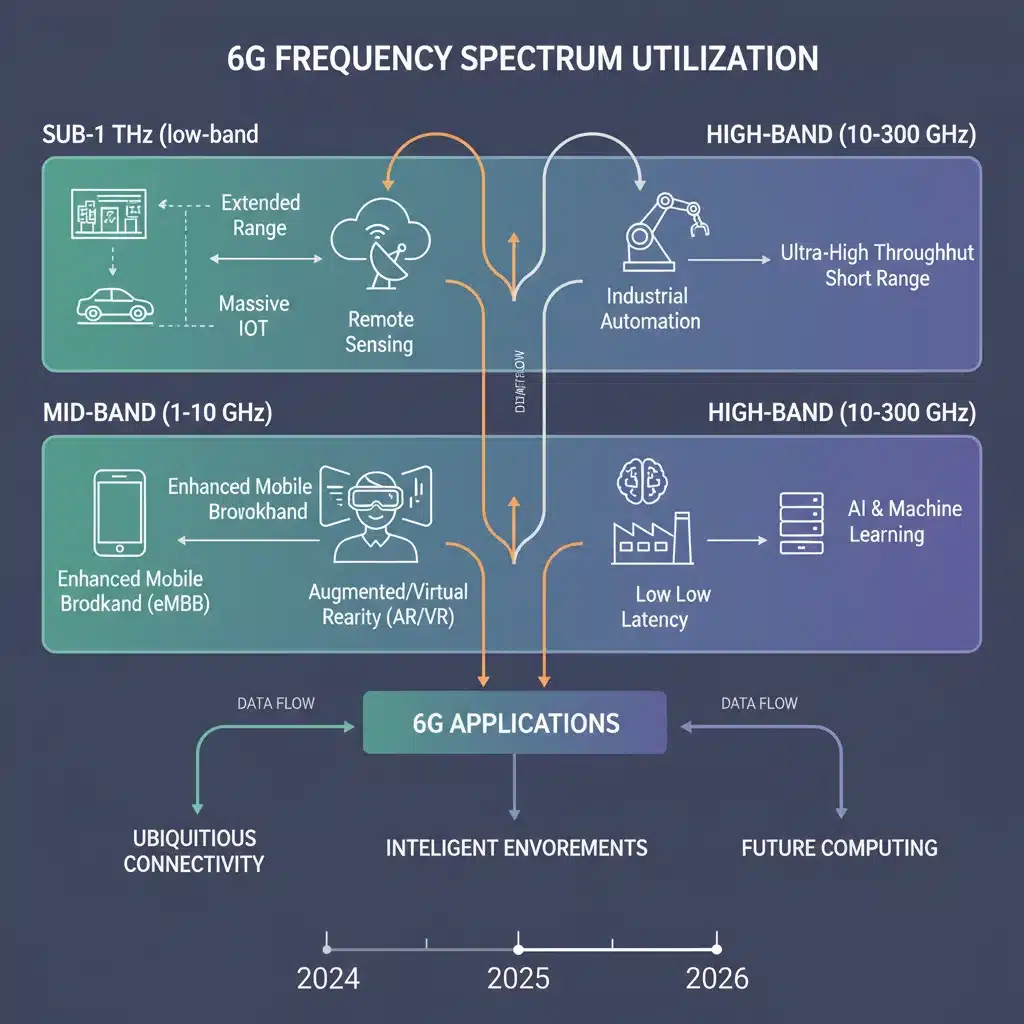
Unlike 5G, which primarily focused on millimeter-wave (mmWave) and mid-band frequencies, 6G is expected to leverage an even broader range of spectrum, from sub-1THz (terahertz) to potentially optical frequencies. The FCC 6G spectrum strategy will likely involve a multi-tiered approach:
Sub-THz Frequencies (100 GHz to 1 THz)
This is arguably the most exciting frontier for 6G. These extremely high frequencies offer enormous bandwidth, capable of supporting incredibly high data rates and ultra-low latency. However, they also present significant challenges:
- Propagation Characteristics: Sub-THz signals are highly susceptible to atmospheric absorption, rain fade, and blockages, leading to very short propagation distances.
- Hardware Complexity: Developing cost-effective and energy-efficient transceivers and antennas for these frequencies is a major engineering hurdle.
- Regulatory Landscape: The FCC will need to carefully identify and clear these bands, which may currently be used for scientific research, sensing, or other niche applications.
U.S. tech companies should be investing in research and development in areas like advanced antenna arrays (e.g., reconfigurable intelligent surfaces, massive MIMO), innovative beamforming techniques, and novel materials science to overcome these propagation challenges.
Mid-Band Spectrum Enhancement
While sub-THz offers capacity, mid-band frequencies (e.g., 3-7 GHz, possibly extending higher) will remain crucial for wide-area coverage and robust connectivity. The FCC may look to reallocate or repurpose existing mid-band spectrum, or explore new contiguous blocks to provide a balance of coverage and capacity for 6G. Companies with expertise in dynamic spectrum sharing (DSS) and cognitive radio technologies will find themselves in a strong position to optimize the use of these valuable airwaves.
Lower Bands for Ubiquitous Coverage
Even with the focus on higher frequencies, lower bands (e.g., sub-1 GHz) will continue to play a role in providing foundational, ubiquitous coverage, especially for IoT devices and remote areas. The FCC 6G spectrum plan will likely ensure that a mix of frequencies is available to support the diverse requirements of 6G applications, from high-throughput data centers to low-power sensor networks.
Key Technological Implications for U.S. Tech Companies
The FCC’s spectrum decisions will have direct and profound implications for various sectors within the U.S. tech industry. Companies need to consider these technological shifts:
1. Advanced Antenna Systems and RF Front Ends
The move to sub-THz frequencies necessitates a revolution in antenna design and RF front ends. Traditional designs won’t suffice. Companies specializing in:
- Massive MIMO and Ultra-Massive MIMO: Scaling up antenna arrays to hundreds or thousands of elements.
- Reconfigurable Intelligent Surfaces (RIS): Passive or semi-passive surfaces that can dynamically steer and focus wireless signals, extending coverage and improving signal quality in challenging environments.
- Terahertz Transceivers: Developing integrated circuits and components capable of operating efficiently at these extremely high frequencies.
- Advanced Materials: Research into new materials for waveguides, substrates, and packaging to minimize losses at THz frequencies.
These areas will see significant investment and innovation as the FCC 6G spectrum becomes clearer.
2. AI/ML Integration for Network Management
The complexity of 6G networks, with their diverse spectrum bands, dynamic resource allocation, and massive number of connected devices, will be beyond human management capabilities. Artificial intelligence and machine learning will be indispensable for:
- Automated Spectrum Management: Real-time optimization of spectrum usage, interference mitigation, and dynamic sharing.
- Predictive Maintenance: Identifying potential network issues before they occur.
- Resource Orchestration: Efficiently allocating computational and communication resources across the network.
- Security: Detecting and responding to cyber threats in real-time.
U.S. tech companies with strong AI/ML capabilities should be exploring how to apply these to 6G network operations.
3. Edge Computing and Distributed Architectures
6G’s vision of ultra-low latency and pervasive intelligence demands a highly distributed network architecture. Edge computing will become even more critical, bringing computation and data storage closer to the end-users and devices. This has implications for:
- Cloud Providers: Extending cloud infrastructure to the network edge.
- Hardware Manufacturers: Developing powerful, compact, and energy-efficient edge devices.
- Software Developers: Creating applications and services designed for distributed environments.
4. Sensing, Imaging, and Localization
A unique aspect of 6G is its potential to integrate communication with sensing, imaging, and precise localization. The same wireless signals used for data transmission can also be used to detect objects, map environments, and provide highly accurate positioning. This opens up new opportunities for companies in:
- Autonomous Vehicles: Enhanced perception and V2X (vehicle-to-everything) communication.
- Smart Cities: Environmental monitoring, traffic management, and public safety.
- Healthcare: Remote patient monitoring, advanced diagnostics, and assistive technologies.
- Industrial Automation: Precision robotics, predictive maintenance, and quality control.
Strategic Steps for U.S. Tech Companies by Q3 2026
To navigate the evolving FCC 6G spectrum landscape successfully, U.S. tech companies must undertake several strategic initiatives:
1. Monitor FCC and International Regulatory Developments Closely
Stay abreast of public notices, proposed rulemakings, and final decisions from the FCC. Participate in public comment periods when appropriate. Also, track the progress of international standards bodies like ITU-R and 3GPP, as global harmonization will be key for device interoperability and market reach.
2. Invest in Research and Development
Allocate resources to R&D focused on 6G-enabling technologies. This includes:
- Sub-THz Component Development: Transceivers, antennas, and filters.
- Advanced Signal Processing: Techniques for overcoming propagation challenges at high frequencies.
- AI/ML for Network Optimization: Algorithms for dynamic spectrum access, resource allocation, and security.
- Integrated Sensing and Communication (ISAC): Exploring dual-use technologies.
3. Forge Strategic Partnerships
No single company can develop the entirety of the 6G ecosystem. Collaborate with:
- Academic Institutions: Leverage cutting-edge research and talent.
- Component Manufacturers: Secure supply chains for new hardware.
- Software Developers: Build applications and platforms that harness 6G capabilities.
- Vertical Industry Players: Understand specific use case requirements (e.g., automotive, healthcare, manufacturing).
4. Develop Intellectual Property (IP)
As the 6G standards begin to solidify, securing patents in key technological areas will be crucial for competitive advantage and revenue generation through licensing. Companies should actively participate in standards development organizations (SDOs) to influence the direction of 6G and ensure their IP is incorporated.
5. Assess and Upgrade Existing Infrastructure
While 6G will introduce new frequencies, it will also need to integrate with existing 5G and fiber optic backbones. Companies should evaluate their current infrastructure for scalability and future-proofing. This includes upgrading optical networks, enhancing data centers, and preparing for denser deployments of small cells and other access points.
6. Talent Acquisition and Training
The specialized skills required for 6G development and deployment are in high demand. U.S. tech companies need to proactively recruit engineers, researchers, and data scientists with expertise in RF engineering, AI/ML, distributed systems, and cybersecurity. Investing in upskilling current employees is equally vital.
Challenges and Considerations
While the opportunities presented by 6G are immense, several challenges must be addressed:
- Cost of Deployment: The infrastructure required for 6G, especially at sub-THz frequencies, will be substantial. The FCC’s policies on spectrum licensing and incentives will play a role in mitigating these costs.
- Energy Efficiency: Operating at higher frequencies and supporting massive numbers of devices requires innovative solutions to manage energy consumption across the network.
- Security and Privacy: With more devices and more data, 6G networks will be prime targets for cyberattacks. Robust security protocols and privacy-by-design principles are essential.
- Digital Divide: Ensuring equitable access to 6G technologies across all communities, urban and rural, will be a significant societal challenge that regulatory bodies and companies must address.
- Global Harmonization: Disparate spectrum allocations across different regions could hinder global interoperability and increase costs for device manufacturers. The FCC’s role in advocating for global alignment is critical.
The Role of the FCC in Shaping the 6G Future
The FCC’s decisions regarding FCC 6G spectrum allocations will be pivotal. Their responsibilities extend beyond merely assigning frequencies; they must also:
- Promote Innovation: Create a regulatory environment that encourages experimentation and the development of new technologies.
- Ensure Competition: Foster a competitive marketplace that benefits consumers and prevents monopolies.
- Manage Interference: Develop rules and mechanisms to prevent harmful interference between different users of the spectrum.
- Support Public Safety: Ensure that critical communications, including emergency services, are protected and prioritized.
- Facilitate Deployment: Streamline permitting processes and reduce regulatory burdens to accelerate infrastructure rollout.
U.S. tech companies should view the FCC not just as a regulator, but as a key partner in shaping the future of wireless communication. Engaging constructively with the commission through various channels can help ensure that policies are well-informed and supportive of technological progress.
Conclusion: Seizing the 6G Opportunity
The race to 6G is accelerating, and the FCC’s spectrum allocations will be the starting gun for many U.S. tech companies. By Q3 2026, a clear roadmap for FCC 6G spectrum is expected to emerge, demanding proactive engagement from industry players. Companies that invest early in R&D, foster strategic partnerships, and closely monitor regulatory developments will be best positioned to capitalize on the transformative potential of 6G. This isn’t just about faster internet; it’s about building the foundation for an entirely new era of intelligent, connected experiences that will redefine industries and daily life. The future is wireless, and 6G is its next frontier.