Student Loan Repayment 2026: New Federal Programs Reduce Monthly Payments by 15%

Student Loan Repayment in 2026: How New Federal Programs Can Reduce Your Monthly Payments by 15%
The landscape of student loan repayment is constantly evolving, and for millions of borrowers, the year 2026 is poised to bring significant changes that could offer substantial financial relief. With the implementation of new federal programs and adjustments to existing ones, there’s a real opportunity to reduce your monthly student loan payments by as much as 15%. This comprehensive guide will delve into the specifics of these upcoming changes, helping you understand how to navigate the new system, what you need to do to qualify, and how to strategically position yourself to take full advantage of these benefits. Our focus keyword, student loan repayment 2026, will guide us through the intricacies of these crucial updates, ensuring you have all the information necessary to make informed decisions about your financial future.
Understanding the Shifting Tides of Student Loan Repayment
For years, student loan debt has been a heavy burden for many, impacting everything from homeownership to retirement planning. The federal government has consistently sought ways to alleviate this pressure, and 2026 marks a pivotal moment with the full rollout of several key initiatives. These programs are designed not just to defer payments, but to genuinely make monthly obligations more manageable, particularly for those with lower incomes or higher debt-to-income ratios. The goal is to create a more sustainable repayment environment, preventing defaults and providing a clearer path to financial stability for borrowers across the nation.
The changes coming in 2026 build upon previous efforts, such as the initial phases of the SAVE Plan (Saving on a Valuable Education), and introduce further enhancements that will significantly alter how discretionary income is calculated and how much borrowers are expected to pay each month. These adjustments are not merely cosmetic; they represent a fundamental shift in the government’s approach to student debt, prioritizing affordability and long-term financial health. Keeping abreast of these developments is crucial for anyone with federal student loans, as proactive engagement can lead to substantial savings and reduced stress.
Advertisements
The SAVE Plan: A Game-Changer for Student Loan Repayment in 2026
At the heart of the student loan repayment 2026 reforms is the full implementation of the SAVE Plan. While elements of the SAVE Plan were introduced earlier, 2026 will see its most impactful provisions come into effect, particularly for undergraduate loans. This plan is an evolution of the Revised Pay As You Earn (REPAYE) program, offering even more generous terms for borrowers. The core principle of the SAVE Plan is to calculate monthly payments based on a borrower’s income and family size, rather than their loan balance, making payments more affordable for those struggling to keep up.
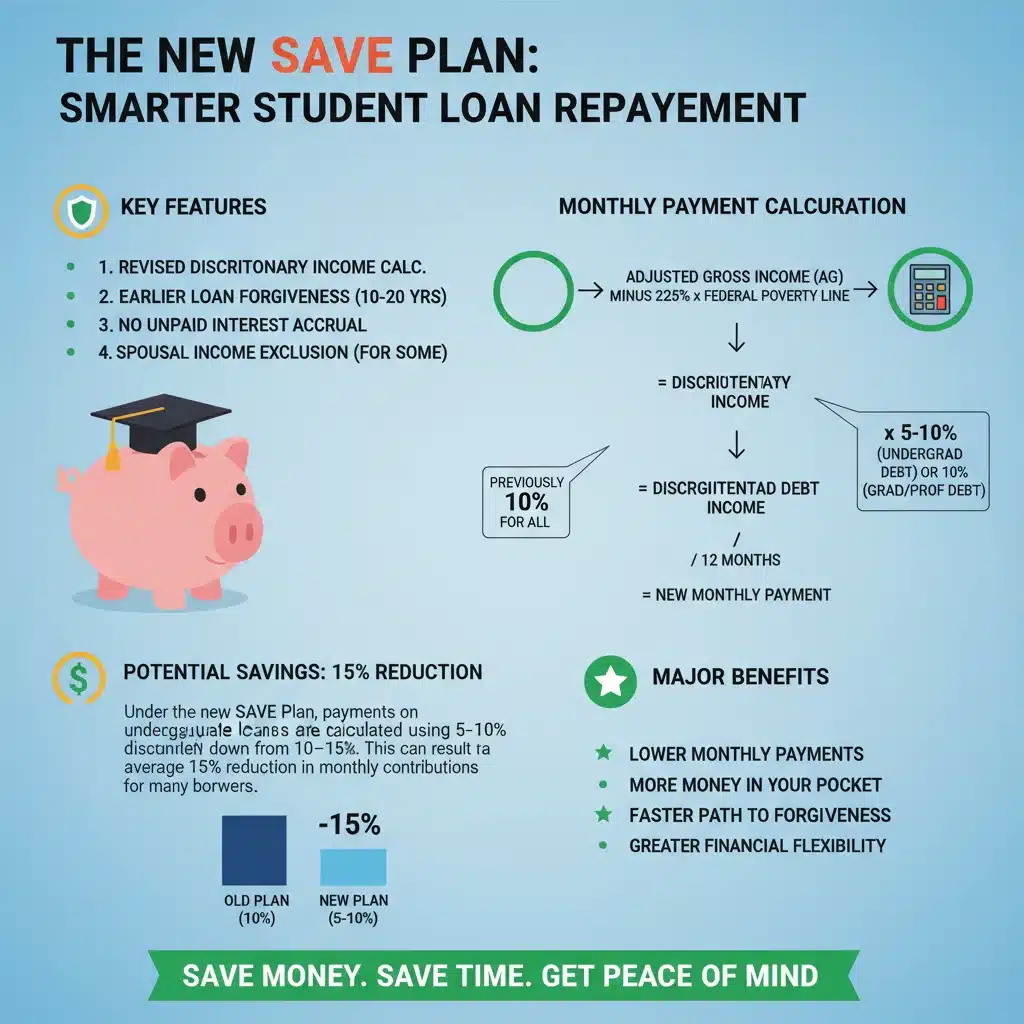
One of the most significant changes under the SAVE Plan for 2026 is the reduction in the percentage of discretionary income used to calculate payments for undergraduate loans. Currently, many income-driven repayment (IDR) plans base payments on 10% of discretionary income. However, under the fully implemented SAVE Plan, this percentage will be slashed to 5% for undergraduate loans. This reduction is monumental, as it directly translates to lower monthly payments for a vast majority of borrowers with undergraduate debt. For those with a mix of undergraduate and graduate loans, a weighted average will be applied, ensuring fairness across different loan types.
Beyond the payment calculation, the SAVE Plan also introduces several other borrower-friendly features. It prevents interest capitalization when payments are too low to cover accruing interest, meaning your loan balance won’t grow as long as you’re making your required payments, even if those payments are $0. This is a crucial protection that wasn’t consistently available under previous IDR plans. Furthermore, the plan offers faster pathways to loan forgiveness for borrowers with smaller original loan balances, potentially as early as 10 years of payments. These combined benefits make the SAVE Plan a powerful tool for managing and ultimately overcoming student debt.
How the 15% Reduction in Payments is Achieved
The promise of a 15% reduction in monthly payments is not an arbitrary figure; it’s a direct outcome of the changes within the SAVE Plan, particularly the adjustment to the discretionary income calculation. Let’s break down how this works. Discretionary income is typically defined as the difference between your adjusted gross income (AGI) and a certain percentage of the federal poverty line. Under older IDR plans, this threshold was often 150% of the poverty line. The SAVE Plan raises this threshold to 225% of the federal poverty line. This means a larger portion of your income is considered non-discretionary, effectively reducing the amount of income subject to the payment calculation.
For example, if your AGI is $50,000 and the 225% poverty line for your family size is $30,000, your discretionary income would be $20,000 ($50,000 – $30,000). If your payments were previously based on 10% of this amount, you’d pay $2,000 annually or approximately $167 per month. With the SAVE Plan’s 5% discretionary income contribution for undergraduate loans, that payment would drop to $1,000 annually or about $83 per month. This represents a significant reduction, often exceeding the 15% benchmark, depending on individual circumstances.
It’s important to note that this 15% reduction is an average or potential maximum. Individual savings will vary based on your specific income, family size, loan type, and total debt. However, the overarching structure of the SAVE Plan, particularly with the 5% discretionary income contribution for undergraduate loans and the higher poverty line threshold, is designed to provide substantial relief across the board. The goal is to ensure that monthly payments are truly affordable, preventing borrowers from having to choose between loan payments and essential living expenses.
Eligibility and Application for the New Programs
To benefit from these new federal programs and potentially reduce your student loan repayment 2026, understanding eligibility criteria and the application process is paramount. The good news is that most federal student loan borrowers are eligible for the SAVE Plan. This includes Direct Loans and FFEL Program loans that are not in default. However, some older federal loan types, such as Perkins Loans or certain FFEL loans held by commercial lenders, may require consolidation into a Direct Consolidation Loan to qualify. It’s always best to check with your loan servicer or the Federal Student Aid website for specific eligibility details tailored to your situation.
The application process for the SAVE Plan is relatively straightforward. You can apply online through the Federal Student Aid (FSA) website (studentaid.gov). You’ll need to provide information about your income and family size, which can often be linked directly to your IRS tax return data for convenience. It’s crucial to reapply or recertify your income and family size annually to ensure your payments remain accurate and you continue to receive the maximum benefit. Missing this annual recertification can lead to your payments reverting to a higher amount or interest capitalization, so setting reminders is highly recommended.
For those already enrolled in an IDR plan like REPAYE, the transition to the SAVE Plan is automatic. However, it’s still a good idea to review your account and ensure your information is up-to-date. If you’re on a different IDR plan (PAYE, IBR, ICR), you can switch to the SAVE Plan at any time. Carefully consider the implications of switching, as it might impact accrued interest or forgiveness timelines depending on your specific loan history. Consulting with a trusted financial advisor or your loan servicer can help clarify the best path forward for your individual circumstances.
Strategic Tips for Maximizing Your Savings
Beyond simply enrolling in the SAVE Plan, there are several strategic steps you can take to maximize your savings and optimize your student loan repayment 2026 experience. These tips are designed to help you navigate the system effectively and ensure you’re getting the most out of the new federal programs.
1. Understand Your Loan Types
Not all federal loans are treated equally under the new programs. Direct Loans are typically the most straightforward to enroll in the SAVE Plan. If you have FFEL loans, Perkins Loans, or other older federal loans, consider consolidating them into a Direct Consolidation Loan. This will make them eligible for the SAVE Plan and other IDR benefits. However, be aware that consolidation can sometimes reset your payment count for forgiveness, so weigh the pros and cons carefully, especially if you’re close to Public Service Loan Forgiveness (PSLF) or IDR forgiveness.
2. Keep Your Income and Family Size Updated
Your monthly payment under the SAVE Plan is directly tied to your income and family size. Any significant changes in either—such as a job loss, a pay cut, marriage, divorce, or the birth of a child—should prompt you to update your information with your loan servicer immediately. You don’t have to wait for your annual recertification. Proactively updating your information can lead to an immediate reduction in your monthly payment, providing quicker relief when you need it most.
3. Explore Public Service Loan Forgiveness (PSLF)
If you work for a government agency or a qualifying non-profit organization, the SAVE Plan can be a powerful complement to Public Service Loan Forgiveness (PSLF). Payments made under the SAVE Plan count towards the 120 qualifying payments required for PSLF. Since SAVE often results in lower monthly payments, it can make your path to PSLF more affordable and sustainable. Ensure you are meeting all PSLF requirements, including working full-time for a qualifying employer and having Direct Loans.
4. Consider Tax Implications of Forgiveness
While loan forgiveness is a significant benefit, it’s essential to understand its potential tax implications. Under current law, forgiveness received through IDR plans (after 20 or 25 years of payments) is generally considered taxable income. However, forgiveness under PSLF is tax-free. As you plan your student loan repayment 2026 strategy, factor in these potential tax liabilities to avoid any surprises down the road. Tax laws can change, so staying informed is crucial.
5. Beware of Scams
Whenever there are significant changes to federal student loan programs, scammers often emerge, promising quick fixes or charging fees for services you can get for free. Be extremely cautious of unsolicited calls, emails, or advertisements promising to erase your debt or guarantee forgiveness. Always go directly to the official Federal Student Aid website (studentaid.gov) or contact your loan servicer for accurate information and to apply for any programs. Never pay for assistance that the Department of Education offers for free.

Comparing the SAVE Plan with Other Repayment Options
While the SAVE Plan offers substantial benefits, it’s not the only repayment option available. Understanding how it compares to other plans can help you make the most informed decision for your student loan repayment 2026 strategy. Here’s a brief comparison:
- Standard Repayment Plan: This plan typically amortizes your loan over 10 years with fixed monthly payments. While it leads to the lowest total interest paid, the monthly payments can be very high, especially for large loan balances. It does not offer the income-driven flexibility of the SAVE Plan.
- Graduated Repayment Plan: Payments start low and gradually increase over time, typically over 10 years. This can be helpful if you expect your income to rise, but it still lacks the income-based protection of the SAVE Plan.
- Extended Repayment Plan: Offers a longer repayment period (up to 25 years) with either fixed or graduated payments. This lowers monthly payments but significantly increases the total interest paid. The SAVE Plan can offer lower payments with potential for forgiveness, often making it a better choice.
- Other Income-Driven Repayment (IDR) Plans (PAYE, IBR, ICR): These plans also base payments on income and family size, but typically use a higher percentage of discretionary income (10-15%) and different poverty line thresholds than the SAVE Plan. The SAVE Plan is generally considered the most beneficial IDR plan for most borrowers, especially those with undergraduate loans, due to its lower discretionary income percentage and interest subsidy.
For most federal student loan borrowers, especially those with undergraduate loans or a need for lower monthly payments, the SAVE Plan will likely be the most advantageous option in 2026. However, it’s always wise to use the Loan Simulator tool on studentaid.gov to compare all available options based on your specific financial situation.
The Broader Impact of Reduced Student Loan Payments
The ability to reduce monthly student loan payments by 15% or more through new federal programs in 2026 has a ripple effect that extends far beyond individual bank accounts. On a macro level, this relief can stimulate the economy. When borrowers have more disposable income, they are more likely to spend, save, or invest, boosting consumer confidence and economic activity. This can translate into increased demand for goods and services, support for small businesses, and even a healthier housing market as more individuals become able to afford down payments.
For individuals, the impact is even more profound. Reduced payments mean less financial stress, allowing borrowers to focus on other critical financial goals. This could include building an emergency fund, saving for a down payment on a home, contributing more to retirement accounts, or even starting a family. The psychological burden of student debt is immense, and easing that burden can lead to improved mental health and overall well-being. It empowers individuals to make life choices based on their aspirations rather than being constrained by overwhelming debt obligations.
Furthermore, these programs contribute to greater equity in education. By making higher education more financially sustainable, they ensure that the pursuit of knowledge and career advancement remains accessible to a wider range of individuals, regardless of their socioeconomic background. This fosters a more educated workforce, drives innovation, and strengthens the nation’s human capital. The long-term benefits of these reforms extend far beyond immediate financial relief, shaping the economic and social fabric of the country for generations to come.
Preparing for 2026: Your Action Plan
As 2026 approaches, proactive preparation is key to ensuring you can take full advantage of the new student loan repayment 2026 programs. Here’s an actionable plan to guide you:
- Review Your Loan Portfolio: Log in to studentaid.gov to view all your federal student loans. Identify the types of loans you have (Direct, FFEL, Perkins) and their current status.
- Update Your Contact Information: Ensure your loan servicer and the Federal Student Aid website have your most current contact information (email, phone, address) so you don’t miss important updates.
- Understand the SAVE Plan: Familiarize yourself with the specifics of the SAVE Plan, particularly the changes coming in 2026 regarding discretionary income calculation and interest subsidies.
- Apply or Switch to SAVE: If you are not already on the SAVE Plan, consider applying through studentaid.gov. If you are on an older IDR plan, evaluate if switching to SAVE is beneficial for your situation.
- Monitor Your Income and Family Size: Be prepared to provide updated income and family size information annually, or whenever there’s a significant change in your financial circumstances.
- Seek Professional Advice: If your situation is complex, consider consulting with a non-profit credit counselor or a financial advisor specializing in student loans.
- Stay Informed: Regularly check the Federal Student Aid website for the latest announcements and guidance regarding student loan policies and programs.
By following these steps, you can ensure you are well-prepared to navigate the evolving landscape of student loan repayment and leverage the new federal programs to achieve significant financial savings in 2026 and beyond.
Conclusion: A Brighter Future for Student Loan Borrowers
The year 2026 holds immense promise for millions of student loan borrowers across the United States. With the full implementation of the SAVE Plan and other federal initiatives, the opportunity to reduce monthly payments by up to 15% is a tangible reality. These programs represent a significant step towards alleviating the burden of student debt, offering a pathway to more affordable payments, interest protections, and ultimately, a clearer road to financial freedom. By understanding the eligibility requirements, actively engaging with the application process, and strategically managing your loans, you can unlock substantial savings and improve your overall financial well-being.
The focus on student loan repayment 2026 is not just about reducing a number on a bill; it’s about empowering individuals to pursue their dreams, build stable financial futures, and contribute to a more robust economy. Don’t let the complexity of the system deter you. Take the time to educate yourself, utilize the available resources, and take proactive steps to ensure you benefit from these transformative changes. A more manageable student loan future is within reach.