Investment Strategies for Beginners 2026: Your First $1,000

Starting your investment journey can feel like stepping into a complex maze, especially when you’re a beginner with a limited amount of capital. However, with the right knowledge and a clear plan, investing your first $1,000 in 2026 is not only possible but can also be the pivotal first step towards significant financial growth. This comprehensive guide will break down the essential beginner investment strategies, helping you navigate the market with confidence and set a strong foundation for your financial future.
Many people believe that you need a large sum of money to start investing, but that’s a common misconception. The truth is, even a modest amount like $1,000 can be a powerful starting point if invested wisely. The key is to understand the principles of investing, choose the right vehicles, and maintain a long-term perspective. In 2026, the financial landscape continues to evolve, offering new opportunities and requiring a keen understanding of modern investment tools and approaches.
This article is specifically designed for those who are new to investing and are looking to make their initial $1,000 work for them. We will cover everything from understanding basic investment concepts to exploring specific investment options suitable for beginners, all while keeping the year 2026 in mind. Our goal is to demystify investing and provide you with actionable beginner investment strategies that you can implement right away.
Advertisements
Understanding the Basics of Investing for Beginners in 2026
Before diving into specific investment options, it’s crucial to grasp some fundamental concepts. Investing isn’t just about picking stocks; it’s about making your money grow over time by putting it into assets that are expected to increase in value. For beginners, understanding risk, diversification, and compound interest are paramount.
What is Risk in Investing?
Every investment carries some level of risk. Risk refers to the possibility that your actual return will be different from your expected return, including the possibility of losing some or all of your initial investment. For beginner investors, it’s important to understand that higher potential returns often come with higher risks. However, there are ways to manage and mitigate risk, which we will explore.
- Market Risk: The risk that the overall market will decline, affecting all investments.
- Specific Risk: The risk associated with a particular company or industry.
- Inflation Risk: The risk that inflation will erode the purchasing power of your returns.
As a beginner, your primary focus should be on understanding your own risk tolerance. Are you comfortable with significant fluctuations in value for potentially higher returns, or do you prefer a more stable, albeit slower, growth path? This self-assessment will guide your beginner investment strategies.
The Power of Diversification
Diversification is perhaps the most critical concept for any investor, especially beginners. It’s the strategy of spreading your investments across various assets to reduce risk. The old adage, "Don’t put all your eggs in one basket," perfectly encapsulates the essence of diversification. If one investment performs poorly, others might perform well, balancing out your overall portfolio. This is a cornerstone of effective beginner investment strategies.
For someone starting with $1,000, true diversification across many individual stocks might be challenging. However, you can achieve diversification through investment vehicles like Exchange Traded Funds (ETFs) or mutual funds, which hold a basket of different securities.
Compound Interest: Your Best Friend
Albert Einstein reportedly called compound interest the "eighth wonder of the world." It’s the process where the interest you earn on your investment also earns interest. Over time, this can lead to exponential growth. The earlier you start investing, the more time compound interest has to work its magic. Even with $1,000, starting early means that amount can grow substantially over decades.
Understanding compound interest is fundamental to long-term wealth building and should be at the heart of all beginner investment strategies. It emphasizes the importance of starting now, even with a small amount.
Setting Clear Financial Goals for Your First $1,000
Before you even think about where to put your money, you need to define your financial goals. What do you want your $1,000 investment to achieve? Are you saving for a down payment on a house, retirement, a child’s education, or simply looking to grow your wealth over the long term? Your goals will significantly influence your beginner investment strategies.
- Short-Term Goals (1-3 years): For short-term goals, you generally want to avoid highly volatile investments. Your $1,000 might be better placed in a high-yield savings account or a Certificate of Deposit (CD) to preserve capital.
- Medium-Term Goals (3-10 years): Here, you can consider a slightly more aggressive approach, perhaps a diversified portfolio of ETFs or mutual funds.
- Long-Term Goals (10+ years): This is where the power of compound interest truly shines. For long-term goals like retirement, you can afford to take on more risk with the expectation of higher returns over time.
For most beginners investing their first $1,000, the focus should typically be on long-term growth. This allows for market fluctuations to even out and gives compound interest ample time to work.
Top Beginner Investment Strategies for Your First $1,000 in 2026
Now that we’ve covered the basics, let’s explore some practical beginner investment strategies specifically tailored for someone starting with $1,000 in 2026.
1. Robo-Advisors: Automated Investing Made Easy
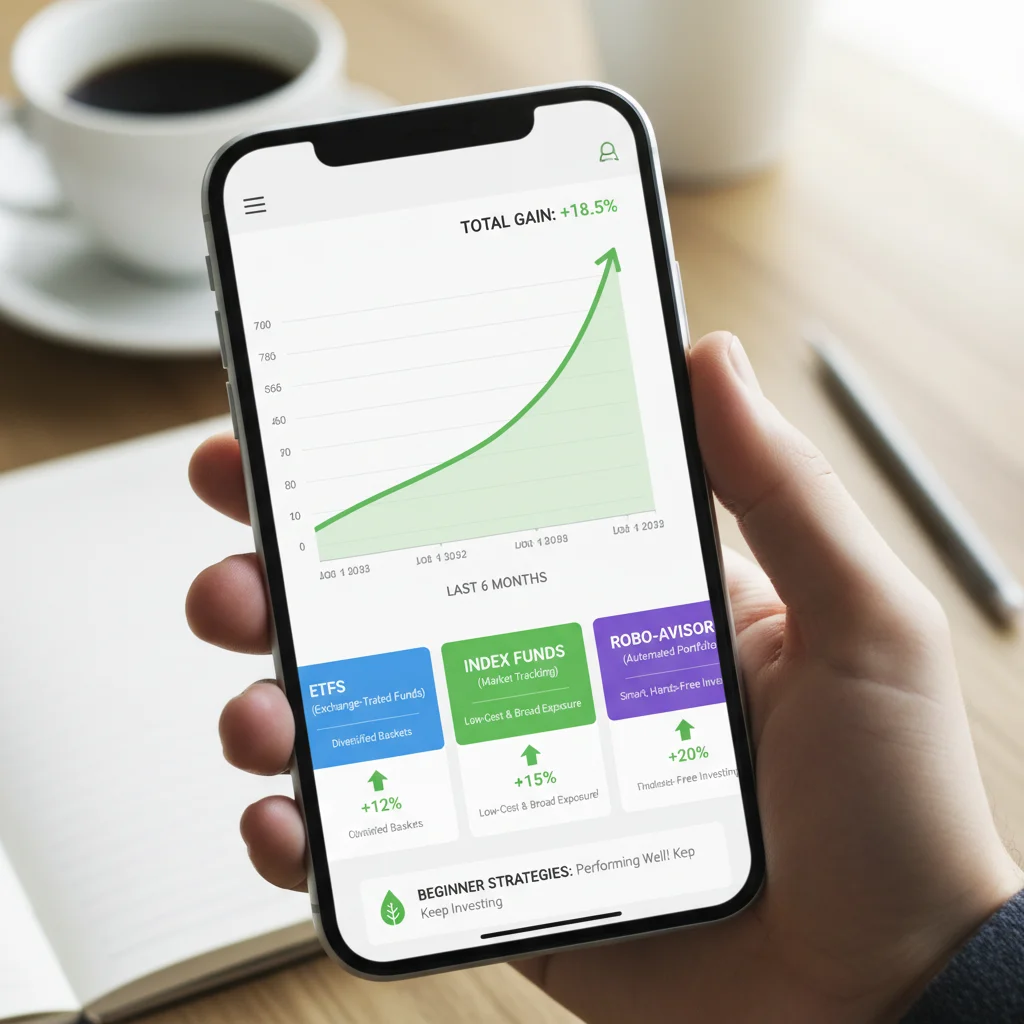
For beginners, robo-advisors are an excellent starting point. These digital platforms use algorithms to manage your investments based on your financial goals and risk tolerance. They offer low fees, automatic rebalancing, and diversified portfolios, making them ideal for those who want a hands-off approach.
Popular robo-advisors in 2026 include:
- Betterment: Known for its goal-based investing and tax-loss harvesting.
- Fidelity Go: A great option for those already with Fidelity accounts, offering low minimums.
- Schwab Intelligent Portfolios: Offers commission-free ETF portfolios with no advisory fees.
Many robo-advisors have low minimum investment requirements, often starting at $0 or $500, making them perfectly suited for your first $1,000. They are designed to simplify the investment process and implement sound beginner investment strategies automatically.
2. Exchange Traded Funds (ETFs): Diversification in a Single Click
ETFs are a fantastic option for beginners because they offer instant diversification across various assets, sectors, or even entire markets. An ETF is a type of investment fund that holds multiple underlying assets, such as stocks, bonds, or commodities, and trades like a regular stock on an exchange.
With $1,000, you can buy shares of several different ETFs, creating a well-diversified portfolio. Some popular types of ETFs for beginners include:
- S&P 500 ETFs (e.g., SPY, VOO, IVV): These track the performance of the 500 largest U.S. companies, offering broad market exposure.
- Total Stock Market ETFs (e.g., VTI, ITOT): These invest in virtually every publicly traded U.S. company, providing even broader diversification.
- International Stock ETFs (e.g., VXUS, IXUS): For global diversification, investing in companies outside the U.S.
- Bond ETFs (e.g., BND, AGG): Can add stability to your portfolio, especially as you get closer to your financial goals.
ETFs are cost-effective, transparent, and provide excellent exposure to different market segments, making them a cornerstone of effective beginner investment strategies.
3. Index Funds: Low-Cost, Broad Market Exposure
Similar to ETFs, index funds (often structured as mutual funds) aim to replicate the performance of a specific market index, like the S&P 500. They are passively managed, which means lower fees compared to actively managed mutual funds. While some index mutual funds might have higher minimum investment requirements, many brokers now offer index ETFs or mutual funds with low or no minimums.
For your first $1,000, investing in a broad-market index fund can be a very sensible approach. It allows you to participate in the overall growth of the economy without trying to pick individual winning stocks, which is often a risky endeavor for beginners. This is a fundamental element of successful beginner investment strategies for long-term growth.
4. Fractional Shares: Making Every Dollar Count
In 2026, many brokerage platforms offer fractional shares, which means you can invest in a portion of a stock or ETF rather than buying a whole share. This is a game-changer for beginners with limited capital. Instead of needing hundreds or thousands of dollars to buy a single share of a high-priced stock, you can invest a specific dollar amount (e.g., $50 or $100) and own a fraction of that share.
This allows you to build a diversified portfolio with your $1,000, even if individual shares are expensive. Fractional shares enable you to truly implement diversified beginner investment strategies without being constrained by share prices.
5. High-Yield Savings Accounts (HYSA) or Certificates of Deposit (CDs) for Short-Term Goals
While not strictly "investing" in the traditional sense, if your financial goal for your $1,000 is short-term (e.g., saving for an emergency fund or a purchase within the next year), a high-yield savings account or a Certificate of Deposit (CD) might be more appropriate. These options offer lower risk and provide a modest return, ensuring your capital is preserved and accessible when you need it.
For any money you might need within the next 1-3 years, prioritizing capital preservation over aggressive growth is a smart move. These are crucial components of well-rounded beginner investment strategies, even if they aren’t directly market-linked.
What to Avoid as a Beginner Investor with $1,000
Just as important as knowing what to invest in, is knowing what to avoid, especially when you’re starting with a limited amount. Avoiding common pitfalls will protect your capital and build good investment habits.
1. Penny Stocks and "Get Rich Quick" Schemes
Resist the temptation of penny stocks (stocks trading for less than $5 per share) or any investment promising unusually high, fast returns. These are often highly speculative and carry extreme risk, making them unsuitable for beginner investment strategies and particularly dangerous for a small initial investment like $1,000.
2. Individual Stock Picking Without Research
While exciting, trying to pick individual winning stocks without thorough research and understanding of the company can be very risky. For beginners, it’s generally better to rely on diversified funds (ETFs, index funds) that spread your risk across many companies.
3. Investing in What You Don’t Understand
Never invest in something you don’t fully comprehend. If an investment seems too complicated or you can’t explain how it makes money, it’s best to steer clear. Stick to transparent and understandable investment vehicles as part of your beginner investment strategies.
4. Chasing Trends or "Hot Tips"
The market is full of hype. Don’t let fear of missing out (FOMO) drive your investment decisions. "Hot tips" rarely pan out, and by the time a trend is widely discussed, it’s often too late to profit significantly. Stick to your well-researched beginner investment strategies.
Building Your Investment Plan: Step-by-Step for Your First $1,000
Now, let’s put it all together into a practical step-by-step plan for your first $1,000 investment in 2026.
Step 1: Open a Brokerage Account
The first practical step is to open an investment account. For beginners, a reputable online brokerage firm is usually the best choice. Look for platforms with low or no trading fees, fractional share capabilities, and a wide selection of ETFs and index funds. Examples include Fidelity, Charles Schwab, Vanguard, E*TRADE, or Robinhood (though be mindful of Robinhood’s limited educational resources for true beginners).
Ensure the platform aligns with your chosen beginner investment strategies.
Step 2: Fund Your Account
Once your account is open, link your bank account and transfer your $1,000. This process is usually straightforward and can be done electronically.
Step 3: Choose Your Investment Vehicle(s)
Based on your financial goals and risk tolerance, decide which investment vehicle(s) are best for you. For most beginners with $1,000, a combination of a low-cost S&P 500 ETF and perhaps an international stock ETF purchased via fractional shares through a robo-advisor or direct brokerage account is an excellent starting point.
For example, you could allocate:
- $500 to a Total Stock Market ETF (e.g., VTI)
- $300 to an International Stock ETF (e.g., VXUS)
- $200 to a Bond ETF (e.g., BND) for a touch of stability.
This provides immediate diversification and aligns with solid beginner investment strategies.
Step 4: Make Your First Investment
Execute your trades. If using a robo-advisor, it will do this automatically. If you’re self-directing, search for the ETF tickers you’ve chosen and place a market order or a limit order (if you want more control over the price).
Step 5: Set Up Automatic Contributions (Crucial for Long-Term Growth)
This is arguably the most important step for long-term success. Set up an automatic transfer from your bank account to your investment account each month, even if it’s just $25, $50, or $100. This practice, known as dollar-cost averaging, allows you to invest regularly regardless of market fluctuations, buying more shares when prices are low and fewer when prices are high. It’s a powerful component of beginner investment strategies.

Key Considerations for 2026 Investors
The year 2026 brings its own set of considerations for investors. While the core principles of investing remain constant, technology, market dynamics, and global events can influence your approach.
Technological Advancements and FinTech
The rise of FinTech (financial technology) continues to democratize investing. User-friendly apps, AI-powered insights, and commission-free trading platforms make it easier than ever for beginners to access the market. Leverage these tools to simplify your beginner investment strategies.
Inflation and Interest Rates
Keep an eye on inflation rates and central bank interest rate policies. High inflation can erode returns, making it crucial to invest in assets that historically outperform inflation. Rising interest rates can impact bond prices and sometimes dampen stock market enthusiasm.
Global Economic Outlook
Stay generally informed about the global economic outlook. While you don’t need to be an economist, understanding broad trends can help you make informed decisions, especially regarding international diversification within your beginner investment strategies.
ESG Investing (Environmental, Social, and Governance)
A growing trend in 2026 is ESG investing, where you choose companies or funds that align with your values regarding environmental protection, social responsibility, and good corporate governance. Many ETFs and mutual funds now focus on ESG criteria, allowing you to invest ethically while pursuing returns.
Maintaining a Long-Term Perspective and Emotional Discipline
One of the hardest but most crucial aspects of successful investing, especially for beginners, is maintaining a long-term perspective and emotional discipline. The market will have its ups and downs. There will be periods of excitement and periods of fear. As a beginner, it’s vital to:
- Avoid Panic Selling: When the market dips, resist the urge to sell your investments in a panic. Historically, markets recover, and panic selling often locks in losses.
- Stay Consistent: Continue with your automatic contributions (dollar-cost averaging) even during downturns. This allows you to buy more shares at lower prices.
- Rebalance Periodically: As your portfolio grows, its asset allocation might drift from your target. Periodically (e.g., once a year), rebalance your portfolio to bring it back in line with your desired risk level. Robo-advisors often do this automatically.
- Educate Yourself Continuously: The more you learn about investing, the more confident and capable you will become. Read books, follow reputable financial news, and understand the assets you own.
These behavioral beginner investment strategies are just as important as the technical ones. Emotional control can make or break your investment success.
Conclusion: Your First $1,000 is Just the Beginning
Investing your first $1,000 in 2026 is a significant milestone on your path to financial independence. By understanding the basics of risk and diversification, setting clear goals, and choosing appropriate investment vehicles like robo-advisors, ETFs, or index funds, you can lay a solid foundation for growth. Remember the power of compound interest and the importance of consistent contributions, even small ones.
Avoid common beginner mistakes like chasing speculative investments or making emotional decisions. Instead, focus on building a diversified portfolio, leveraging fractional shares, and maintaining a long-term perspective. The financial world of 2026 offers numerous accessible tools and resources for you to succeed.
Your first $1,000 is not just money; it’s a seed that, with careful nurturing and smart beginner investment strategies, can blossom into substantial wealth over time. Start today, stay disciplined, and watch your financial future unfold.