6G Technology: The Future of Connectivity and Its Impact on Your Devices

Unveiling the Power of Future 6G Technology: What It Means for Your Devices in 2026 and Beyond
The world is constantly evolving, and at the heart of this evolution lies communication technology. From 1G to 5G, each generation has brought about monumental shifts in how we connect, work, and live. Now, as 5G becomes more prevalent, the whispers of the next frontier are growing louder: future 6G technology. This isn’t just an incremental upgrade; it’s a vision of a truly connected, intelligent, and immersive world. But what exactly is 6G, when can we expect it, and how will it fundamentally change the devices we use every day? Let’s embark on a journey to explore the revolutionary potential of future 6G technology.
The Dawn of a New Era: What is Future 6G Technology?
Future 6G technology represents the sixth generation of wireless communication, promising to push the boundaries of what’s currently possible with 5G. While 5G is characterized by high speeds, low latency, and increased capacity, 6G aims to deliver even more extreme performance metrics, opening doors to applications that are currently in the realm of science fiction. Think terabit-per-second (Tbps) speeds, microsecond latency, and unparalleled reliability. This isn’t just about faster downloads; it’s about creating a seamless, intelligent environment where physical and digital worlds merge.
The core tenets of future 6G technology revolve around several key advancements. Firstly, it will leverage much higher frequency bands, including terahertz (THz) spectrum, which offers vast bandwidth potential. Secondly, it will integrate artificial intelligence (AI) and machine learning (ML) natively into the network architecture, making the network itself intelligent and self-optimizing. Thirdly, 6G is envisioned to support ubiquitous connectivity, extending beyond terrestrial networks to include satellite and aerial platforms, ensuring coverage even in remote areas. Finally, it will focus on creating a truly immersive experience, enabling advanced holographic communications, fully tactile internet, and real-time digital twins.
Advertisements
Understanding the fundamental differences between 5G and 6G is crucial. While 5G laid the groundwork for enhanced mobile broadband (eMBB), ultra-reliable low-latency communications (URLLC), and massive machine-type communications (mMTC), 6G will amplify these capabilities exponentially. It will move beyond merely connecting devices to creating an ‘Internet of Senses’ and an ‘Intelligent Connectivity’ paradigm. This means devices won’t just transmit data; they will perceive, learn, and interact with their environment and with each other in unprecedented ways, all powered by the robust backbone of future 6G technology.
The Anticipated Timeline: When Can We Expect 6G?
While 5G is still being rolled out globally, research and development for future 6G technology are already well underway. Historically, each generation of wireless technology has had roughly a 10-year cycle. Following this pattern, with 5G commercialization beginning around 2020, we can anticipate the initial commercial deployment of 6G around 2030. However, the foundational research, standardization efforts, and early trials are expected to gain significant momentum in the mid-2020s, with a projected target of 2026 for critical breakthroughs and the establishment of key technological pillars.
Several countries and major telecommunication companies are heavily investing in 6G research. For instance, countries like China, Japan, South Korea, Finland, and the United States have established dedicated research programs and alliances to accelerate 6G development. The International Telecommunication Union (ITU) will play a crucial role in defining the global standards for 6G, a process that typically takes several years. This standardization is vital to ensure interoperability and seamless global connectivity, preventing fragmentation in the market.
The journey to 6G will involve several phases. The current phase is primarily focused on theoretical research, identifying potential frequency bands, developing new antenna technologies, and exploring novel modulation schemes. The mid-2020s (around 2026) will likely see the emergence of early prototypes, proof-of-concept demonstrations, and the solidification of key architectural components. By the late 2020s, we can expect pre-commercial trials and the finalization of standards, paving the way for widespread commercial deployment by 2030. This gradual progression ensures that the complex technological challenges are addressed systematically, leading to a robust and reliable future 6G technology infrastructure.
Transforming Your Devices: The Impact of 6G Connectivity
The advent of future 6G technology will not just make your current devices faster; it will fundamentally redefine what a ‘device’ can be and what it can do. The unprecedented speed, ultra-low latency, and massive connectivity will enable a new generation of smart devices that are more intelligent, autonomous, and integrated into our lives than ever before.
Smartphones and Wearables: Beyond Current Capabilities
Your smartphone, already a powerful tool, will transform into a hyper-connected, AI-powered hub. With 6G, holographic communication could become commonplace, allowing you to interact with 3D projections of people or objects in real-time. Augmented Reality (AR) and Virtual Reality (VR) will achieve photorealistic immersion, with no noticeable lag, making remote collaboration feel like in-person meetings. Wearable devices, from smartwatches to smart glasses, will gain advanced sensing capabilities, offering real-time health monitoring with medical-grade precision and personalized AI assistance that anticipates your needs.
The processing power required for such advanced applications will not solely reside on the device. Instead, 6G will enable seamless offloading of intensive computations to edge and cloud servers with virtually zero latency, making even the smallest wearables capable of complex AI tasks. This distributed intelligence, powered by future 6G technology, will lead to devices that are not just smart, but truly intelligent and context-aware.
The Internet of Things (IoT) on Steroids: Ubiquitous Intelligence
The current IoT ecosystem, while expanding, is often limited by connectivity and processing power. 6G will supercharge the IoT, enabling the connection of trillions of devices, each communicating with extremely low power consumption and high reliability. Smart homes will evolve into truly intelligent environments, where every appliance, sensor, and surface is connected and responsive to your presence and preferences. Smart cities will leverage 6G for real-time traffic management, environmental monitoring, and public safety, creating safer and more efficient urban spaces.
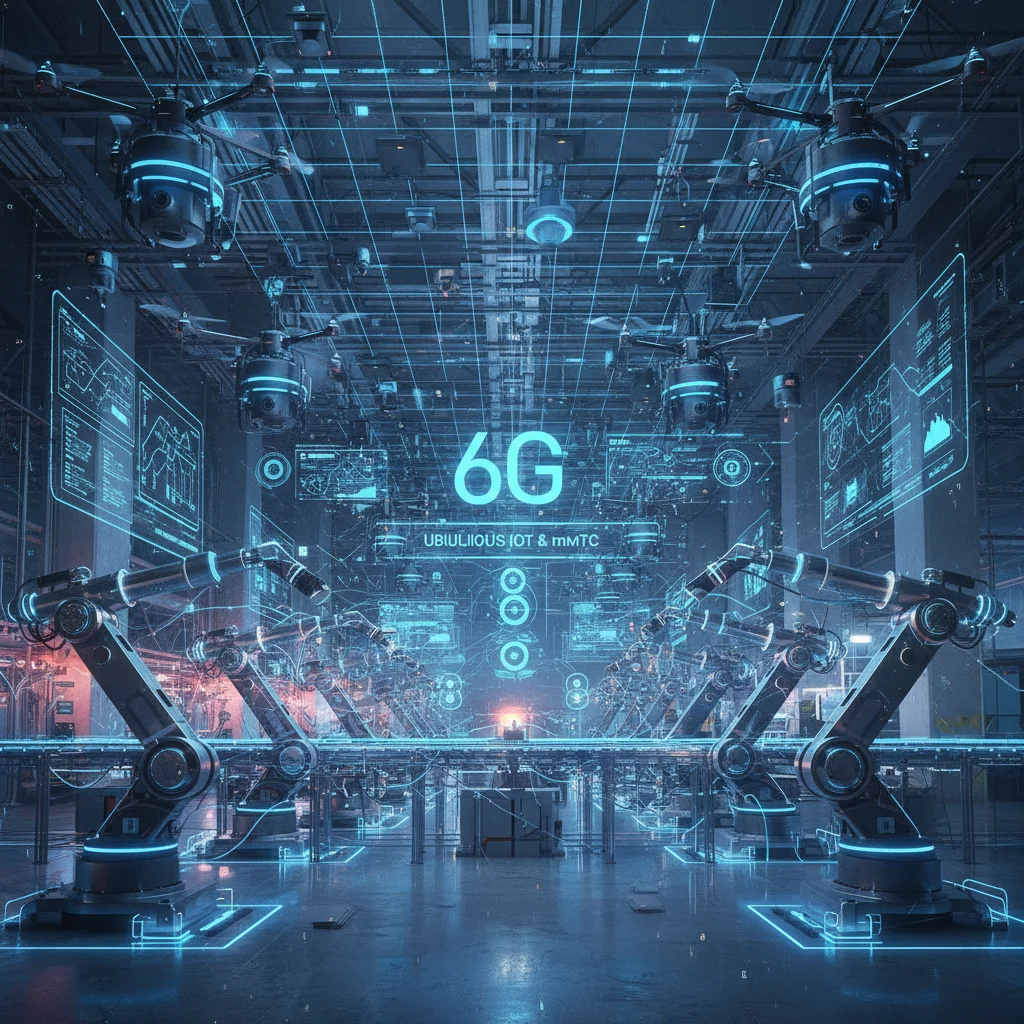
Beyond consumer applications, industrial IoT (IIoT) will experience a revolution. Factories will become fully autonomous, with robots and machines communicating instantly to optimize production, predict maintenance needs, and ensure safety. Logistics and supply chains will achieve unprecedented levels of transparency and efficiency. This massive machine-type communication (mMTC) at 6G speeds and reliability will be a cornerstone of the next industrial revolution, making every ‘thing’ a data point and every process optimized by intelligent connectivity. The scale and density of devices supported by future 6G technology will be orders of magnitude greater than 5G.

Autonomous Systems: Cars, Drones, and Robotics
Autonomous vehicles, including self-driving cars, delivery drones, and advanced robotics, will reach their full potential with future 6G technology. The ultra-low latency and high reliability of 6G are critical for vehicle-to-everything (V2X) communication, allowing cars to communicate with each other, with infrastructure, and with pedestrians in real-time. This will enable truly accident-free transportation, optimized traffic flow, and enhanced safety features.
Drones will perform complex tasks autonomously, from package delivery to infrastructure inspection and emergency response, operating in coordinated swarms. Robots in various sectors, from healthcare to manufacturing, will gain enhanced agility and precision, collaborating seamlessly with humans and other machines. The ability of 6G to provide highly accurate localization and sensing capabilities will be crucial for the safe and efficient operation of these autonomous systems, allowing them to navigate complex environments with unprecedented awareness and responsiveness.
Key Technologies Powering Future 6G Technology
Achieving the ambitious goals of 6G requires significant technological breakthroughs across multiple domains. Several key areas of innovation are being explored to bring future 6G technology to fruition:
Terahertz (THz) Communication
While 5G utilizes millimeter-wave (mmWave) frequencies, 6G will push into the terahertz (THz) spectrum (0.1 THz to 10 THz). This band offers enormous bandwidth, enabling data rates of up to 1 Tbps. However, THz waves have high path loss and are easily blocked, requiring advanced antenna technologies like reconfigurable intelligent surfaces (RIS) and massive MIMO (Multiple-Input Multiple-Output) to overcome these challenges. These technologies will intelligently shape and direct THz beams, ensuring robust connectivity even in challenging environments.
Integrated AI and Machine Learning
AI will not just be an application running on 6G; it will be an integral part of the network itself. AI-powered network management will enable self-optimizing networks that can predict traffic patterns, allocate resources dynamically, and detect and mitigate security threats in real-time. Edge AI, where AI processing occurs closer to the data source, will be crucial for enabling ultra-low latency applications and distributed intelligence across the 6G ecosystem. This inherent intelligence will make future 6G technology networks more efficient, resilient, and adaptable.
Sensing and Localization
6G networks are envisioned to go beyond communication and become highly accurate sensing platforms. By analyzing radio signals, 6G can provide precise localization of devices and objects, even in environments where GPS is unavailable. This capability can be used for environmental monitoring, gesture recognition, human presence detection, and even material characterization. This ‘sensing as a service’ will open up new possibilities for augmented reality, autonomous navigation, and intelligent environment control, adding another layer of utility to future 6G technology.
Beyond Terrestrial Networks: Non-Terrestrial Networks (NTN)
To achieve ubiquitous connectivity, 6G will integrate non-terrestrial networks (NTN) such as satellites, high-altitude platform stations (HAPS), and drones. This will extend coverage to remote areas, oceans, and even airspace, ensuring seamless connectivity for global applications. NTN will also provide resilience in disaster scenarios, offering alternative communication pathways when terrestrial networks are compromised. This multi-layered network architecture is a key differentiator of future 6G technology, guaranteeing connectivity everywhere.
Challenges and Considerations for 6G Deployment
While the promise of future 6G technology is immense, several significant challenges must be addressed before its widespread deployment. These include technical hurdles, regulatory complexities, and ethical considerations.
Technical Hurdles
Operating in the THz spectrum presents significant engineering challenges, including developing efficient THz transceivers, managing high path loss, and designing advanced antenna arrays. The energy efficiency of 6G networks will also be critical, given the increased complexity and demand for processing. Furthermore, ensuring backward compatibility with existing networks while introducing revolutionary new features will require careful planning and innovative solutions. The sheer volume of data generated and processed by 6G will also demand advancements in data storage, processing, and security.
Security and Privacy
With an unprecedented number of interconnected devices and the deep integration of AI, security and privacy will be paramount concerns for future 6G technology. Protecting sensitive data from cyber threats, ensuring the integrity of AI algorithms, and safeguarding user privacy in an ‘Internet of Senses’ environment will require robust new cryptographic techniques, blockchain integration, and advanced security protocols. The network’s ability to sense and perceive its environment also raises important questions about data collection and consent.
Regulatory and Standardization Efforts
The global standardization of 6G is a monumental task. Harmonizing frequency allocations across different regions and establishing common protocols are essential for global interoperability. Regulatory bodies will need to adapt quickly to the new capabilities and potential societal impacts of 6G, addressing issues suchs spectrum licensing, data governance, and ethical AI development. International collaboration will be key to avoiding a fragmented 6G landscape.
Societal Impact and Ethical Considerations
The pervasive nature of 6G, with its ability to collect vast amounts of data and enable highly autonomous systems, raises profound ethical questions. Issues such as algorithmic bias, data ownership, the digital divide, and the potential for misuse of advanced sensing capabilities must be carefully considered and addressed during the development phase. Ensuring that future 6G technology benefits all of humanity, rather than exacerbating existing inequalities, will require a concerted effort from policymakers, industry leaders, and researchers.
The Economic and Societal Benefits of Future 6G Technology
Despite the challenges, the economic and societal benefits of future 6G technology are expected to be transformative. It will drive innovation across virtually every sector, creating new industries, jobs, and economic opportunities.
Economic Growth and Innovation
6G will catalyze economic growth by enabling new services and business models. Industries like healthcare, manufacturing, transportation, and entertainment will be revolutionized, leading to increased productivity, efficiency, and personalized experiences. The development and deployment of 6G infrastructure, hardware, and software will create a massive global market, stimulating investment and research. The ability to process and analyze vast datasets in real-time will unlock new insights and drive data-driven innovation.
Enhanced Quality of Life
For individuals, 6G will lead to a significantly enhanced quality of life. Advanced telemedicine, personalized education, immersive entertainment, and seamless connectivity will become standard. Smart homes and cities will be more responsive, efficient, and safer. The ability to connect remote communities and provide access to high-speed internet will bridge digital divides, fostering greater inclusion and opportunities for underserved populations. The Internet of Senses, powered by future 6G technology, could offer new ways for people with disabilities to interact with the world.
Sustainability and Environmental Impact
6G also holds the potential to contribute to sustainability efforts. By enabling more efficient resource management, optimizing energy consumption in smart grids, and facilitating precision agriculture, 6G can help reduce environmental impact. The real-time monitoring of environmental conditions and the deployment of intelligent sensor networks can aid in climate change mitigation and disaster response. However, the energy consumption of 6G networks themselves will need to be carefully managed through innovative power-saving techniques and renewable energy integration.
Conclusion: Preparing for the Hyper-Connected World of 6G
The journey towards future 6G technology is an exciting and complex one. While 2026 marks a crucial period for its foundational development, the full impact of 6G will be felt throughout the next decade and beyond. It promises to deliver a hyper-connected, intelligent, and immersive world where devices are not just tools but extensions of our senses and intelligence. From holographic communications to fully autonomous systems and an omnipresent Internet of Things, 6G will redefine our interaction with the digital and physical realms.
As we anticipate the arrival of 6G, it’s clear that the advancements will require significant collaboration between researchers, industry leaders, and policymakers. Addressing the technical challenges, ensuring robust security and privacy, and navigating the ethical landscape will be paramount. However, the potential rewards – a more connected, efficient, and intelligent society – make the pursuit of future 6G technology an endeavor worth every effort. Get ready for a future where your devices don’t just connect; they perceive, learn, and interact, transforming every aspect of your digital life.